


Moving Into Your Rental Before Selling: How Much CGT Does It Genuinely Save?

Index:
Moving Into Your Rental Before Selling: How Much CGT Does It Genuinely Save?
Moving into a rental property before selling it can reduce your Capital Gains Tax bill, but only in proportion to the time you genuinely live there as your home, and HMRC's own manual on the meaning of residence confirms there is no minimum period of occupation that automatically qualifies, nor any guaranteed benefit from a short stay.
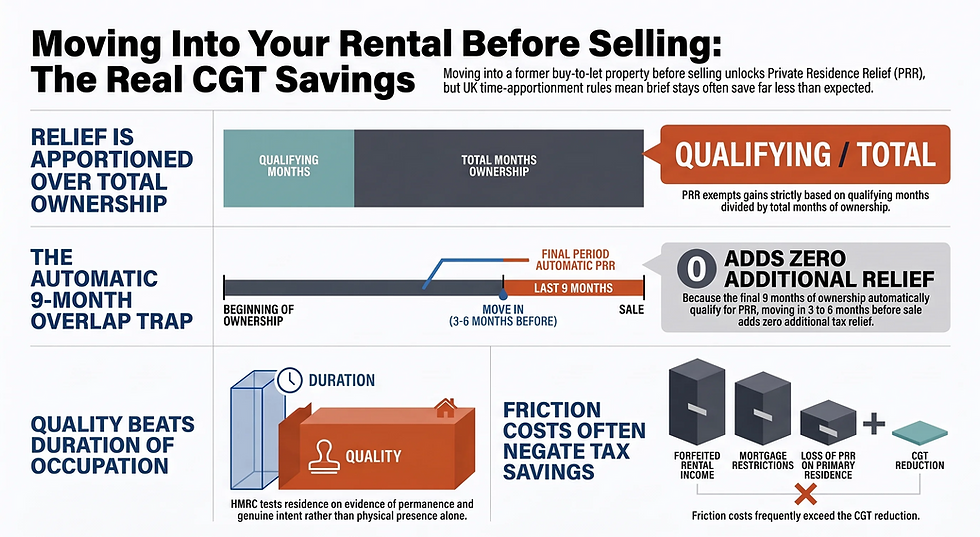
For 2026/27, Private Residence Relief (PRR) is calculated by time-apportioning the gain across your whole period of ownership, with the final nine months always treated as qualifying regardless of whether you were actually living there, which means a brief move-in shortly before a sale often achieves considerably less than people expect.
This is a question I get asked constantly, usually framed as "if I move in for six months, does that make the sale tax-free?" The honest answer depends entirely on timing, genuine intention, and evidence, and the maths behind it is less generous than the internet folklore around this idea suggests.
How Private Residence Relief Is Actually Calculated
PRR exempts the proportion of your gain that relates to periods when the property was genuinely your only or main residence. The calculation is a straightforward fraction: qualifying months of ownership, including the final nine months of ownership regardless of actual occupation during that period, divided by total months of ownership, applied to the total chargeable gain.
That final nine months matters enormously to this question, because it is automatic. HMRC's helpsheet on Private Residence Relief confirms this applies to any property that was genuinely your main residence at some point during ownership, whether or not you were living there during those last nine months, and this period was reduced from 18 months to 9 months for disposals on or after 6 April 2020.
The Trap: Moving In Right Before Selling Achieves Almost Nothing
Here is where the maths catches people out. If you plan to sell within the next nine months anyway, and you move into the property now with the intention of selling shortly afterward, the final nine-month rule already covers that entire window, provided the property does become your genuine residence for at least part of it. Moving in three months before completion, when you were always going to sell within nine months of that point regardless, adds nothing to your PRR claim that the automatic final period would not have given you anyway.
Take a landlord who has owned a flat for eight years, letting it throughout, and decides to move in for the final four months before selling, believing this will meaningfully reduce their CGT bill. Because those four months fall entirely within the final nine months of ownership, which are automatically treated as a qualifying period regardless of actual occupation, moving in achieved precisely nothing beyond what would have applied had they simply sold the property while still tenanted, or even left it empty for those same four months. The gain calculation is identical either way. The genuine benefit only starts to appear where the period of actual occupation extends beyond nine months before the eventual sale, since only that additional period, beyond the automatic final nine months, adds anything new to the qualifying fraction.
Interactive Explainer on: Moving Into Your Rental Before Selling - The Real CGT Saving
This interactive visual explainer evaluates whether moving into a rental property prior to disposal genuinely reduces your UK Capital Gains Tax liability under Private Residence Relief rules, or falls foul of the statutory nine-month deemed occupation trap. By entering your purchase and sale figures alongside your total ownership and occupation periods, you can instantly compare your chargeable gain against a standard buy-to-let sale while viewing your real-time tax savings at current 18% and 24% rates. Simply adjust the sliders, explore the timeline breakdown, and review the case law and evidential audit checklist to assess whether your intended period of residence demonstrates the required degree of permanence to withstand HMRC scrutiny.
A Worked Example Showing the Real Saving
Take the same flat, purchased for £180,000 nine years ago and now sold for £360,000, a gain of £180,000 before reliefs. If the landlord lets it throughout ownership and sells without ever moving in, no PRR applies at all, and the full £180,000 is chargeable, less the £3,000 annual exempt amount for 2026/27, taxed at 18% or 24% depending on their income.
Now suppose the same landlord moves in and genuinely lives there for eighteen months before selling, a period considerably longer than the automatic final nine months. Total ownership is 108 months. The qualifying period is the 18 months of actual occupation, which already includes the final nine months within it since those are the months immediately before sale, so no separate addition is needed beyond the 18 months genuinely lived in. The qualifying fraction is 18 divided by 108, or one-sixth. PRR exempts £30,000 of the £180,000 gain, leaving £150,000 chargeable rather than the full £180,000, a real and meaningful reduction, but one that required genuine, extended occupation to achieve, not a token final stay.
The Quality of Occupation Test: Why HMRC Can Refuse the Claim Entirely
Beyond the arithmetic, there is a more fundamental hurdle, and it is the one most likely to derail a landlord who assumes any period of physically living somewhere automatically counts. HMRC's guidance confirms there is no minimum period of occupation required in principle, but case law is equally clear that occupation must amount to genuine residence, not simply temporary accommodation. The leading authority is Goodwin v Curtis, where the Court of Appeal held that a taxpayer who occupied a farmhouse for just 32 days before it was sold had not established a residence there at all, since he had already instructed agents to sell the property before he moved in. The court's reasoning, since applied consistently in later cases, was that residence requires "some assumption of permanence, some degree of continuity, some expectation of continuity", and HMRC's own manual confirms this test is one of quality rather than quantity of occupation.
This does not mean short periods automatically fail. In Davidson v HMRC, a taxpayer who lived in a flat for just ten weeks before it was let, following a relationship breakdown that cut short his genuine plan to live there long term, successfully claimed PRR because the tribunal accepted his original intention had been genuine, even though circumstances changed unexpectedly.
Contrast this with Paul Gibson v HMRC, where a taxpayer stayed in a property for four to five months using only very basic furniture before an eventual sale, and the tribunal denied relief specifically because the quality of that occupation, sparse, minimal, clearly transitional, did not demonstrate the necessary degree of permanence, regardless of the length of stay. A landlord who moves into a rental property, brings minimal furniture, makes no effort to register locally, and sells shortly afterward is following almost exactly the pattern that failed in Gibson, and HMRC is well practised at identifying this pattern, since it is a common and fairly obvious attempt to secure relief without genuine occupation.
UK CGT Savings Analysis on Moving Into Rental Property
Move-In & Ownership Scenario | Statutory PRR Exempt Months | CGT Payable & Estimated Net Savings | Key Compliance Risks & Financial Frictions |
Standard Pure Buy-to-Let Property (Never Lived In) Landlord owns rental property for full period (e.g., 10 years / 120 months) and sells directly after tenant departs without moving in. | 0 months | CGT Payable: £21,000–£48,000 (standard 18%/24% rates after £3,000 AEA). Net Savings: £0 (Baseline case). | Fully exposed to CGT; 60-day reporting and payment window via Digital UK Property Service; zero friction or risk regarding residency audits. |
Move-In at Start, Then Let Out Lived in as primary residence initially (e.g., first 2 years), then let out for remaining ownership period (e.g., 8 years). | 33 months (24 actual occupied months + final 9 months statutory exemption). | CGT Payable: Reduced by ~27.5% (33/120 months exempt). Net Savings: ~£10,000–£13,200. | Low risk if genuine initial residence; requires early move-in and capital tied up in secondary accommodation during rental period. |
Late Move-In Prior to Sale (Genuine Occupation: 6–18 Months) Landlord moves into rental property as main residence 6 to 18 months prior to selling after a long rental period. | 15–18 months (6–18 actual occupied months + final 9 months statutory exemption). | CGT Payable: £12,000–£39,240 (reduced proportionately). Net Savings: £3,240–£9,000 gross savings (often neutralised or reduced by frictions). | Lost rental yield (£1,500/mo gross); BTL to residential remortgage costs/penalties; high HMRC scrutiny on 'quality of occupation' (permanence, continuity, electoral roll, utility bills); exposure of original primary home under s222(5) dual-residence rules. |
Brief / Token Move-In Before Sale (<3 Months) Attempting a short, temporary move-in (e.g., 32 days to 11 weeks) shortly before selling to trigger PRR. | 0 months (PRR claim disallowed/denied by HMRC). | CGT Payable: Full CGT liability assessed (~£21,000+). Net Savings: £0 (Negative net financial outcome). | Extreme risk of HMRC rejection under Goodwin v Curtis precedence; risk of 20.5%–70% deliberate/careless inaccuracy penalties under Schedule 24; interest charges; relies heavily on proving genuine unexpected life events or original intent ( David Morgan , Lam v HMRC , Davidson v HMRC ). |
What Evidence HMRC Actually Looks For
Given that residence is a question of fact rather than a fixed rule, the evidence you can produce afterward matters enormously if HMRC challenges the claim. Cases that have succeeded on genuinely short periods of occupation, such as Davidson, and cases that have failed on similarly short periods, such as Gibson and Hashmi v HMRC, are distinguished largely by the strength of supporting evidence: utility bills addressed to the individual at that property, council tax registration and electoral roll entries, bank statements and insurance documents using that address, GP registration, and evidence of genuine day-to-day life being conducted from there.
In Hashmi, the taxpayer's claim failed in part because she remained on the electoral register at a different address throughout the period she claimed to be resident at the property in question, a detail that undermined the entire claim regardless of how the occupation itself was described.
For a landlord genuinely planning to move into a rental property before eventually selling, the practical lesson is to treat this as establishing a real, evidenced home from the outset, updating your address with your bank, your GP, the electoral roll, and your insurer promptly, rather than treating the move as a formality to tidy up only if HMRC ever asks. Waiting until a challenge arrives to try to reconstruct this evidence rarely works as well as having it in place contemporaneously.
Lettings Relief Will Not Help in This Scenario
It is worth being clear that lettings relief, the further relief that can apply alongside PRR, will not assist a landlord in this specific situation. Since 6 April 2020, lettings relief only applies where the owner was in shared occupation with a tenant during the letting period, meaning they lived in the property alongside the tenant at the same time. A landlord who lets a property to tenants under an ordinary tenancy, then later moves in themselves once the tenants have left, was never in shared occupation with anyone, and so no lettings relief is available on the earlier letting period at all, regardless of how the ownership timeline is structured.
Practical Considerations While Living There
Once you genuinely move into a previously let property, the Section 24 mortgage interest restriction, which applies to residential landlords, stops being relevant for that period, since the property is no longer generating rental income for you to set finance costs against. If the property is still held on a buy-to-let mortgage rather than a residential one, however, you should check your lender's terms before moving in, since occupying a property mortgaged under a buy-to-let product without the lender's consent can breach the mortgage conditions entirely, an issue separate from tax but one that regularly catches landlords out at exactly the point they are trying to plan their exit carefully.
Interactive Explainer on: Moving Into Your Rental Before Selling
This interactive explainer shows UK landlords exactly how much Capital Gains Tax they can genuinely save by moving into a rental property before selling, and why a short stay often achieves far less than expected. It breaks down Private Residence Relief for the 2026/27 tax year, including the automatic final nine-month rule, the quality-of-occupation test and the key cases HMRC relies on. Simply enter your purchase price, sale price, total ownership period and the number of months you plan to live there, then choose your CGT rate to see an instant estimate of the tax saving. Use the results alongside the practical guidance below to decide whether a genuine, well-evidenced move-in is worthwhile for your situation.
Scotland and Wales: No Separate Treatment
Private Residence Relief, the time-apportionment calculation, the automatic final nine-month period, and the quality of occupation test established through Goodwin v Curtis and the cases that followed it, all apply identically across the whole of the UK, since Capital Gains Tax is reserved to the UK government. A landlord in Scotland or Wales moving into a former rental property before selling faces exactly the same rules, the same evidential expectations, and the same CGT rates of 18% and 24% for 2026/27 as a landlord anywhere else in the UK, with no separate devolved version of any part of this relief.
Practical Steps Worth Taking
● Work out how many months before your intended sale you would need to move in for the occupation period to extend meaningfully beyond the automatic final nine months, since anything shorter than that adds little to your PRR claim.
● Treat the move as establishing a genuine, evidenced home from day one, updating your address with your bank, GP, insurer, and the electoral roll promptly rather than waiting to see if it is ever questioned.
● Keep utility bills, insurance documents, and any other correspondence addressed to you at the property throughout your occupation, since this is exactly the evidence that has determined the outcome in the tribunal cases on this issue.
● Check whether your existing mortgage permits you to occupy the property yourself before you move in, particularly if it was taken out as a buy-to-let product.
● Remember that lettings relief will not apply to the earlier period the property was let to tenants, since you were never in shared occupation with them, so do not build that relief into your calculation.
Key Takeaways
Moving into a rental property before selling can produce a genuine, worthwhile reduction in your CGT bill, but only where the occupation extends meaningfully beyond the automatic final nine months already built into the relief, and only where that occupation looks and is documented like a real home rather than a brief, convenient stay timed around a sale. A short, sparse period of occupation close to completion risks achieving nothing at all, or worse, being challenged and refused outright, while a genuine move sustained for a year or more, properly evidenced from the outset, delivers a real and defensible saving.
FAQs
If I move into my rental property for a few months before selling, will the whole gain become tax-free?
No. Private Residence Relief only exempts the proportion of the gain relating to your genuine period of occupation, plus the automatic final nine months of ownership. A short stay close to the sale date often falls entirely within that automatic period and adds nothing extra to your claim.
Is there a minimum time I need to live somewhere before it counts as my residence for tax purposes?
No fixed minimum exists. HMRC's own guidance confirms there is no minimum period, but case law requires the occupation to show genuine permanence, continuity, or expectation of continuity, which is a question of quality and evidence rather than a set number of days or months.
What happened in the Goodwin v Curtis case, and why does it matter?
A taxpayer who occupied a farmhouse for 32 days, having already instructed agents to sell it before moving in, was found not to have established a residence there at all. This case remains the leading authority HMRC relies on whenever it challenges a short-term occupation claim.
Can a very short period of occupation still qualify for relief?
Yes, potentially. In Davidson v HMRC, a genuine ten-week occupation qualified because the tribunal accepted the taxpayer's original intention to live there long term was real, even though circumstances beyond his control cut the stay short.
What evidence should I keep to support a claim that I genuinely lived somewhere?
Utility bills, council tax and electoral roll registration, bank statements, insurance documents, and GP registration addressed to that property all help demonstrate genuine occupation, and cases have failed specifically where this kind of evidence was missing or contradicted the claim.
Does lettings relief apply if I move into a property I previously rented out to tenants?
No. Since 6 April 2020, lettings relief only applies where you shared occupation with a tenant at the same time. Moving in after tenants have already left does not create shared occupation, so no lettings relief is available on the earlier letting period.
Does the Section 24 mortgage interest restriction still apply once I move into the property myself?
No, not for the period you are living there, since the property is no longer generating rental income for you during that time. You should still check your mortgage terms, however, since a buy-to-let mortgage may not permit you to occupy the property without your lender's consent.
How is the final nine months of ownership treated for relief purposes?
The final nine months are always treated as a qualifying period, whether or not you were actually living there, provided the property was genuinely your main residence at some point during your ownership. This automatic period is why moving in shortly before a planned sale often changes very little.
Is the tax treatment different if the property is in Scotland or Wales?
No. Private Residence Relief, the calculation method, and the quality of occupation test all apply identically across the whole of the UK, since Capital Gains Tax is reserved to the UK government with no separate Scottish or Welsh version of this relief.
About the Author:

Adil Akhtar, ACMA, CGMA, FCMA (membership ID is 990250923) serves as CEO and Chief Accountant at Pro Tax Accountant, bringing over 18 years of expertise in tackling intricate tax issues. As a respected tax blog writer, Adil has spent more than eighteen years delivering clear, practical advice to UK taxpayers. He also leads Advantax Accountants (registered with Companies House), combining technical expertise with a passion for simplifying complex financial concepts, establishing himself as a trusted voice in tax education.
Email: adilacma@icloud.com
Disclaimer: This article sets out the general position under UK tax law for the 2026/27 tax year. The information has been checked against HMRC guidance and other official sources at the date shown above, and is reviewed when the rules change. Tax legislation is complex and outcomes depend on your individual circumstances, so this article is provided for general information and does not constitute advice on which you should act. Any figures or worked examples are illustrative. Before making any decision, obtain advice specific to your situation from a qualified professional. Pro Tax Accountant accepts no liability for loss arising from reliance on this article alone.

.png)