


The £2.5 Million Relief Cap For Couples: Using Both Allowances Before The Second Death

The £2.5 Million Relief Cap for Couples: Using Both Allowances Before the Second Death
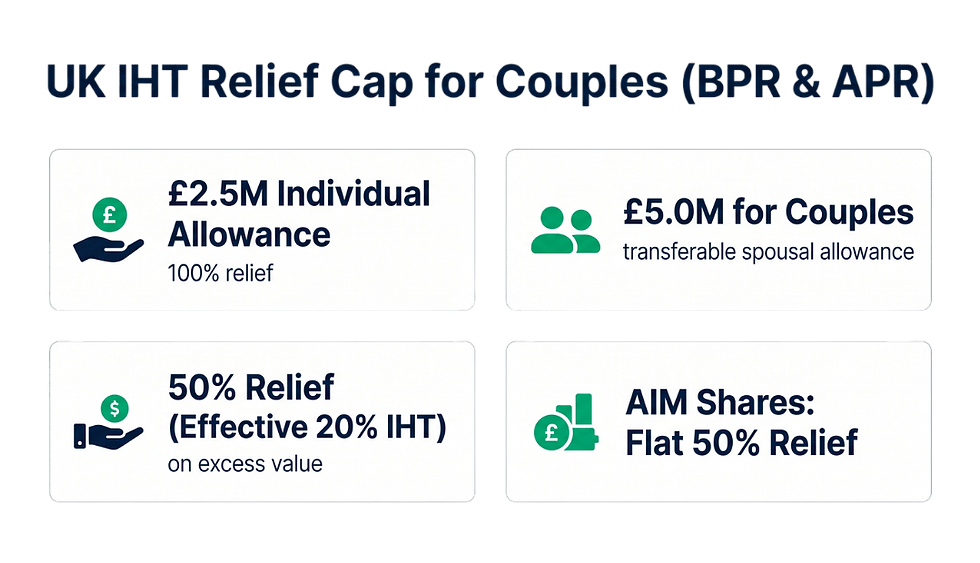
From 6 April 2026, each individual has a £2.5 million allowance for 100% Business Property Relief (BPR) and Agricultural Property Relief (APR) combined, with qualifying value above that relieved at only 50%, an effective 20% Inheritance Tax (IHT) rate. Crucially, and contrary to what a good deal of still-circulating commentary says, any unused portion of that allowance is now transferable between spouses and civil partners on death, following a government amendment confirmed in the Finance Act 2026, which received Royal Assent on 18 March 2026. A married couple can, with the right planning, shelter up to £5 million of combined business and agricultural property at 100% relief, on top of their nil-rate bands.
I want to deal with the transferability point first, because it changes the entire planning conversation and a lot of what business owners and farming families read over the past eighteen months is now out of date. When this reform was first announced at the Autumn Budget in October 2024, the £1 million allowance on offer was explicitly non-transferable, full stop. That single design feature drove an enormous amount of anxious lifetime planning: advisers up and down the country were telling clients that if the first spouse to die left everything to the survivor under spousal exemption, as most wills for married couples do, the deceased's allowance would simply evaporate, unused and unusable, at the point of the first death.
Two rounds of amendment later, first confirming transferability at the Autumn Budget in November 2025, then raising the allowance itself from £1 million to £2.5 million on 23 December 2025, the position has moved substantially in taxpayers' favour, a legislative journey set out in detail in the House of Commons Library briefing on changes to agricultural and business property reliefs. If you were advised under the original proposal and have not revisited that advice since, it is worth doing so now.
What the £2.5 Million Allowance Actually Covers
The allowance applies to the combined value of property that would otherwise qualify for 100% relief under BPR or APR, whichever combination applies to the estate. Where an individual's qualifying assets exceed £2.5 million, the excess is not lost entirely; it receives relief at 50% instead, which in practice means IHT is charged at an effective rate of 20% on the value above the allowance, rather than the standard 40%. Property that only ever qualified for 50% relief in the first place, certain types of let land or minority holdings in businesses controlled by someone else, for example, does not count towards the £2.5 million allowance at all, because it was never in line for 100% relief to begin with.
One change that sits alongside the allowance and catches out business owners who have not reviewed their shareholdings recently: shares admitted to trading on a recognised stock exchange but not listed there, which includes shares on the Alternative Investment Market (AIM), now attract only 50% relief regardless of value, with no access to the £2.5 million allowance on those specific holdings. A client who moved family trading company money into AIM-listed shares for BPR purposes under the old, unlimited 100% regime needs that decision revisited, because the relief landscape those shares sit in has changed independently of the allowance itself.
The cap applies not only to the death estate but to lifetime transfers that are immediately chargeable, such as gifts into a discretionary trust, and to failed potentially exempt transfers where the donor dies within seven years. Anti-forestalling provisions mean that gifts made between 30 October 2024 and 5 April 2026 are drawn into the new regime if the donor dies on or after 6 April 2026 and within seven years of the gift, so lifetime giving carried out in that window needs checking against the current rules rather than the rules that applied at the time of the gift.
What this Widget is About: Designed by Pro Tax Accountant, this interactive visual explainer simplifies the UK’s inheritance tax rules on Business and Agricultural Property Relief (BPR and APR) introduced under the Finance Act 2026. It demonstrates how married couples and civil partners can combine their individual £2.5 million allowances to shield up to £5 million in qualifying trading or farming assets from Inheritance Tax at 100% relief, whilst highlighting the impact of future enterprise growth and the 50% relief rate on unquoted AIM shares. To use the tool, simply adjust the interactive sliders to match your estimated estate value and projected growth, and explore the strategy tabs to compare the tax outcome of relying on a spousal transfer against proactive lifetime planning.
How Transferability Actually Works Between Spouses
The mechanism is designed to mirror the transferable nil-rate band, which most advisers and a good many clients already understand from ordinary estate planning: on the second death, the unused percentage of the first spouse's £2.5 million allowance carries forward and adds to the survivor's own £2.5 million, up to a combined maximum of £5 million. Where a couple's wills leave everything to the survivor on first death, which remains the overwhelming majority of married couples' wills, no BPR or APR relief will have been used on the first death because nothing chargeable arose, spousal exemption having covered the whole estate. That means the full 100% of the first spouse's allowance is treated as unused and is available to transfer.
The change that will matter most to older widows and widowers is that this transfer works retrospectively. Where the first spouse died years, or decades, before 6 April 2026, the survivor is treated as if the deceased had the full £2.5 million allowance available at the time, and any unused percentage transfers forward in the normal way. A surviving spouse whose husband or wife died in, say, 2015, long before this relief cap existed, is not shut out of the transfer simply because the concept did not exist at the time of the first death.
The executors administering the second estate need to actively make the claim and provide the necessary detail about the first death, and this is a step I would expect many executors, and some less specialist advisers, to overlook in the early years of the new rules simply because it is unfamiliar. Given the government's stated intention that the new allowance broadly follows the nil-rate band model, it is reasonable to expect the same restriction that applies there, namely that the maximum enhancement available to a survivor from one or more earlier marriages is capped at 100% of one person's allowance, so a survivor cannot accumulate more than a doubled £5 million regardless of how many previous spouses predeceased them; HMRC has not yet published detailed guidance confirming this specific point, so it is worth checking as practice settles rather than assuming.
Where "Using Both Allowances Before the Second Death" Still Genuinely Matters
Given transferability now exists, the original urgency behind this article's framing has softened considerably for the straightforward case of a married couple who will each leave everything to the other. But there remain several situations where planning to use both allowances actively, rather than relying on the automatic transfer, still produces a materially better result.
Asset growth between the two deaths. If a trading business or farm is likely to grow significantly in value over the years between the first and second death, waiting for the automatic transfer means all of that growth sits inside the survivor's estate, covered only by the combined £5 million rather than having been sheltered earlier by removing part of the asset base from the estate altogether. A couple confident their business will roughly double in value over the next decade may do considerably better by using one spouse's allowance now, through a lifetime transfer into trust or an outright gift of shares to the next generation, rather than banking on the transfer mechanism to catch up later.
AIM and other 50%-only assets. Because these no longer benefit from the allowance regardless of value, transferability between spouses does nothing for them. Business owners holding this kind of stock for IHT planning purposes need a different strategy, potentially restructuring into fully qualifying unquoted trading company shares where that is commercially sensible, rather than assuming the £2.5 million allowance offers any protection.
Unmarried couples and business partners. Spousal exemption and allowance transferability apply only to married couples and civil partners. Cohabiting partners, however long-standing the relationship, and business partners who are not married to each other, get none of this. Each individual's own estate needs to make direct use of their own £2.5 million allowance, typically by ensuring qualifying assets pass to chosen beneficiaries, often children, directly from their own estate rather than assuming any transfer will occur, because none will.
Trusts and their own separate allowance. Relevant property trusts holding BPR or APR qualifying assets have their own £2.5 million allowance, refreshed at each ten-year anniversary, entirely separate from the settlor's personal estate allowance. A trust that was already holding qualifying assets on 30 October 2024 retains the full £2.5 million allowance for its first ten-year charge; a trust set up afterwards, if it shares a settlor with another such trust, shares a single allowance between them rather than each getting its own. For business owners already using trusts as part of succession planning, this is worth reviewing specifically, since the interaction between a settlor's personal allowance and a trust's allowance is a distinct question from spousal transferability.
What this Widget is About: This interactive explainer clearly sets out the new £2.5 million combined allowance for 100% Business Property Relief and Agricultural Property Relief that applies from 6 April 2026, including how any unused portion transfers between spouses and civil partners so that a couple can potentially shelter up to £5 million at full relief. It walks you through the practical rules, highlights situations where active planning still matters despite transferability, and provides a simple calculator so you can estimate the potential Inheritance Tax exposure on your own figures. Use the tabs at the top to move between sections, expand the accordion items for more detail, and try the calculator with your own asset values to see the impact immediately. The whole widget has been prepared by Pro Tax Accountant to give UK taxpayers a clear, up-to-date overview of this important change.
A Worked Example
Take a couple who jointly built a manufacturing business now worth £7 million in total, held as £5 million in the husband's name and £2 million in the wife's, both qualifying in full for 100% BPR, alongside a modest let cottage that only ever qualified for 50% relief and so sits outside the allowance calculation entirely. The husband dies first, leaving his entire estate to his wife under spousal exemption, so no BPR is actually used on his death and 100% of his £2.5 million allowance transfers to her. On the wife's later death, assuming the business is still worth broadly the same combined figure and has by then passed entirely into her estate through the earlier transfer, her own estate holds business property of £7 million against a combined allowance of £5 million (her own £2.5 million plus her late husband's transferred £2.5 million).
The first £5 million receives 100% relief; the remaining £2 million receives 50% relief, producing an effective IHT charge of 20% on that £2 million, roughly £400,000, payable by her executors, potentially by instalments over ten years without interest on qualifying business and agricultural property. Had the couple instead restructured ownership during the husband's lifetime so that each used their own allowance against separately held qualifying assets passing to their children on their respective deaths, rather than funnelling everything through the survivor, that £400,000 exposure could, depending on how the restructuring was carried out and how long they each survived any lifetime transfer, have been avoided or substantially reduced.

Scottish and Welsh Positions
Inheritance Tax, including BPR, APR, and the new £2.5 million allowance, is a reserved matter of UK taxation and applies identically across Scotland, Wales, England, and Northern Ireland, since IHT is not devolved. Where Scotland genuinely differs is in succession law rather than tax law. Scots law gives a surviving spouse or civil partner, and children, statutory legal rights to a share of a deceased person's moveable estate, broadly cash, shares, and personal property rather than heritable property such as land and buildings, regardless of what the will says.
Where a Scottish business owner's will leaves everything to the surviving spouse on the assumption that spousal exemption and full allowance transfer will follow automatically, a claim for legal rights by a child could disturb that assumption by diverting part of the moveable estate away from the spouse, potentially triggering an unexpected IHT charge on the first death rather than achieving the intended full exemption. This is a point worth raising specifically with Scottish clients holding qualifying business assets, since it has no equivalent under English or Welsh succession law. Welsh estates follow the same succession law as England and Wales generally, so no separate adjustment is needed there beyond the reserved UK tax position itself.
FAQs
Is the £2.5 million APR and BPR allowance really transferable now, or is that still under discussion?
It is settled law. The Finance Act 2026 received Royal Assent on 18 March 2026, and it confirms both the increase from the originally proposed £1 million to £2.5 million and full transferability between spouses and civil partners, effective from 6 April 2026. Advice or articles describing the allowance as non-transferable reflect the original October 2024 proposal, not the law as enacted.
If my spouse died years ago, before this relief cap existed, can I still benefit from their unused allowance?
Yes. The transfer works retrospectively, treating a spouse who died before 6 April 2026 as having had the full £2.5 million allowance available, with any unused percentage transferring forward to the survivor in the normal way.
Do we need to do anything, or does the allowance transfer automatically like the nil-rate band?
The executors of the second estate need to actively claim the transfer, in a similar way to claiming the transferable nil-rate band using form IHT402, rather than it happening automatically. This is a step worth flagging clearly to whoever administers the estate, since it is easy to overlook in the early years of an unfamiliar rule.
Do AIM shares still get any benefit from the £2.5 million allowance?
No. Shares admitted to trading on a recognised exchange but not officially listed, which includes AIM, receive only 50% relief regardless of value and do not draw on or benefit from the £2.5 million allowance at all. This is a separate change from the allowance itself and applies to both spouses independently.
Does the allowance apply per couple or per individual?
Per individual. Each person has their own £2.5 million allowance; the transferability rule means an unused allowance from a deceased spouse can add to the survivor's own, producing a combined maximum of £5 million for a couple, rather than the couple sharing a single £2.5 million pot from the outset.
We are not married but have been together for many years and jointly run a business. Does any of this transferability help us?
No. Spousal exemption and allowance transferability are available only to married couples and civil partners. Unmarried partners each need to plan around their own £2.5 million allowance independently, typically by ensuring qualifying assets pass from their own estate directly to their intended beneficiaries.
Should we still consider lifetime gifting given the allowance now transfers on death?
It depends heavily on how much your qualifying assets are likely to grow in value and how confident you are in surviving any gift by seven years. Where significant growth is expected, using an allowance during lifetime, rather than relying on the value being sheltered later by the combined £5 million on second death, can still produce a better outcome, though lifetime gifting carries its own risks and should not be treated as automatically superior.
Does a trust holding our business shares have its own separate £2.5 million allowance, or does it use up our personal one?
A relevant property trust has its own £2.5 million allowance, refreshed at each ten-year anniversary, which is separate from the settlor's personal estate allowance. Where multiple trusts share the same settlor and were created on or after 30 October 2024, they share a single allowance between them rather than each getting its own.
About the Author:

Adil Akhtar, ACMA, CGMA, FCMA (membership ID is 990250923) serves as CEO and Chief Accountant at Pro Tax Accountant, bringing over 18 years of expertise in tackling intricate tax issues. As a respected tax blog writer, Adil has spent more than eighteen years delivering clear, practical advice to UK taxpayers. He also leads Advantax Accountants (registered with Companies House), combining technical expertise with a passion for simplifying complex financial concepts, establishing himself as a trusted voice in tax education.
Email: adilacma@icloud.com
Disclaimer: This article sets out the general position under UK tax law for the 2026/27 tax year. The information has been checked against HMRC guidance and other official sources at the date shown above, and is reviewed when the rules change. Tax legislation is complex and outcomes depend on your individual circumstances, so this article is provided for general information and does not constitute advice on which you should act. Any figures or worked examples are illustrative. Before making any decision, obtain advice specific to your situation from a qualified professional. Pro Tax Accountant accepts no liability for loss arising from reliance on this article alone.

.png)