


Selling Two Businesses In One Lifetime: Tracking The £1 Million Lifetime Limit Across Disposals

Selling Two Businesses in One Lifetime: Tracking the £1 Million Lifetime Limit Across Disposals
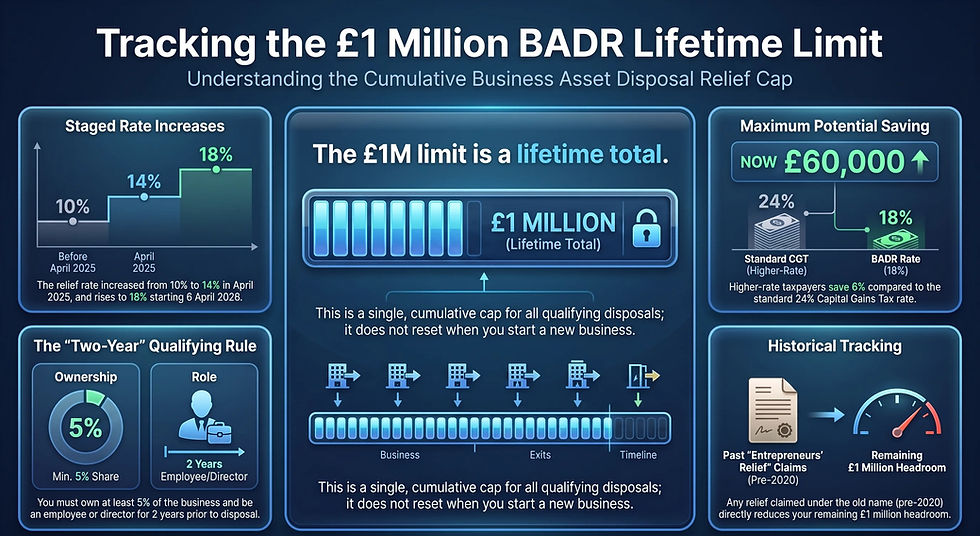
Business Asset Disposal Relief (BADR) carries a lifetime limit of £1 million in qualifying gains, and that limit applies cumulatively across every disposal you ever make, not per business, per company, or per tax year. For 2026/27, the reduced rate applied to gains within that limit is 18%, up from 14% in 2025/26 and 10% before 6 April 2025, and a serial entrepreneur who sells a second or third business needs to track exactly how much of that £1 million allowance remains, because the answer is rarely as simple as it first appears.
I see this trip people up more than almost any other aspect of exit planning. A founder sells one company, uses part of the lifetime limit without necessarily realising it precisely, and years later sells a second business assuming a fresh allowance applies. It doesn't. The limit follows the individual, not the business, and it accumulates for as long as you are a UK taxpayer making qualifying disposals.
The Lifetime Limit Is About Gains, Not Tax Paid
The first distinction worth being precise about is that the £1 million limit measures the value of qualifying gains, not the amount of tax saved or paid. HMRC's own guidance on how to claim Business Asset Disposal Relief confirms there is no limit to how many times you can claim the relief, but that you can claim a total of £1 million in Business Asset Disposal Relief over your lifetime, with the figure reduced from £10 million for disposals made before 11 March 2020. This means the rate applied to your gain, whether 10%, 14%, or 18% depending on when each individual disposal took place, is irrelevant to how much of the £1 million pot you have used. What matters is the pound value of the gain itself, after allowable losses and before the annual exempt amount is applied against it.
This produces a subtlety that catches out advisers who are not paying close attention to the history of a client's disposals. Someone who sold a business in 2018 under the old £10 million lifetime limit may have used, say, £3 million of qualifying gain against that historic limit, all taxed at the 10% rate that applied then. When they come to sell a second business now, in 2026/27, they are not starting fresh, and they are not simply comparing their new gain against the current £1 million figure in isolation. HMRC's transitional treatment for pre-11 March 2020 disposals needs to be checked directly, since the guidance is explicit that individuals who used part of the earlier, higher limit should contact HMRC to establish their remaining position rather than assume the current £1 million figure applies from a blank slate.
A Worked Example Across Two Disposals
Take a founder, Ines, who sold her first business, a specialist logistics company, in August 2019, realising a qualifying gain of £1.4 million, taxed in full at the then-prevailing 10% BADR rate under the £10 million lifetime limit that applied at the time. She then built a second business, a software consultancy, and sells her shares in it in November 2026, realising a qualifying gain of £650,000.
Because her first disposal took place before 11 March 2020, it was measured against the £10 million limit in force at the time, and did not itself reduce what would later become the £1 million limit introduced from that date. Ines's remaining lifetime limit going into her 2026/27 disposal is therefore the full £1 million, not £1 million minus her 2019 gain, since her earlier disposal falls outside the scope of the current limit's cumulation. Her £650,000 gain in November 2026 qualifies in full for BADR at the 2026/27 rate of 18%, producing a tax charge of £117,000 rather than the £156,000 she would have paid at the standard 24% rate on a gain of that size outside BADR. She still has £350,000 of her current £1 million lifetime limit remaining for any future qualifying disposal.
Change the facts slightly and the answer looks different. If Ines's first disposal had instead taken place in July 2021, after the £1 million limit came into force, her £1.4 million gain would already have exceeded the entire lifetime limit on its own, meaning BADR would have covered only the first £1 million of that gain, with the remaining £400,000 taxed at standard rates, and she would have no lifetime limit left at all for her 2026 software company sale. The date of the earlier disposal, not just its size, is what determines how much room remains.
What this Widget Tells Us: This interactive calculator helps you track and forecast your remaining Business Asset Disposal Relief (BADR) allowance when selling more than one business across your lifetime. By factoring in previous exits, associated property rent restrictions, and the relevant tax year rates—including the 18% rate for 2026/27—it clearly illustrates how much of your statutory £1 million lifetime limit has been absorbed. Simply select a pre-set scenario or adjust the sliders to enter your disposal dates and qualifying capital gains to see an instant breakdown of the relief applied, your standard Capital Gains Tax on any excess, and your formal HMRC claim deadlines.
What Counts as a Qualifying Disposal Towards the Limit
The lifetime limit is not restricted to straightforward company share sales. HMRC's eligibility guidance for Business Asset Disposal Relief sets out several distinct categories that all draw from the same £1 million pot: the sale of all or part of a sole trader or partnership business, the disposal of assets after such a business has ceased trading (provided the disposal happens within three years of cessation), the sale of shares in a personal company where you hold at least 5% of both ordinary share capital and voting rights and are an officer or employee, and what is known as an "associated disposal", where you personally own an asset, such as a commercial property, that you have let your business partnership or personal company use, and you dispose of it alongside your withdrawal from the business itself.
Associated disposals carry a specific restriction worth understanding if you have ever charged your own company rent for use of a property you own personally. HMRC's helpsheet HS275 sets out that relief on an associated disposal can be restricted where the asset was not used entirely for the purposes of the business, or where you received rent for letting the business use it, since charging a market rent is treated as inconsistent with the asset being genuinely part of your withdrawal from the business. This is a detail that regularly reduces a claim more than clients expect, and it is worth reviewing before assuming a jointly timed property and share sale will attract full relief on both elements.
There is also a specific carve-out for shares acquired under an Enterprise Management Incentive (EMI) scheme, which can qualify for BADR even where the ordinary 5% personal company test is not met, reflecting the fact that EMI shares are often granted to key employees who never hold a large enough stake to pass the standard shareholding threshold. And where a shareholding is diluted below 5% because a company issues further shares as part of a funding round, an election is available to treat the shares as sold and reacquired at market value immediately before the dilution, preserving eligibility for the gain accrued up to that point even though the eventual full disposal may happen after the 5% threshold has been lost.
Investors' Relief: A Separate £1 Million Pot, Not the Same Limit
A common and understandable confusion is assuming that Investors' Relief shares the same lifetime limit as BADR. It does not. Investors' Relief applies to external investors in unquoted trading companies who are not officers or employees, and it carries its own separate lifetime limit, reduced from £10 million to £1 million for disposals on or after 30 October 2024, with the rate aligned to BADR at 18% for 2026/27. A business owner who has used their full BADR lifetime limit on a company they built and ran can, in principle, still have a separate £1 million of headroom under Investors' Relief if they later make a qualifying investment in an unrelated trading company where they take no employment role. The two limits are tracked entirely independently by HMRC and should not be netted against each other when working out what allowance remains for a future disposal.

The Claim Deadline and Why Historic Disposals Get Lost
BADR is never given automatically. It must be actively claimed, and the deadline is the first anniversary of the 31 January Self Assessment filing deadline following the tax year of disposal, meaning a disposal made in the 2026/27 tax year has a claim deadline of 31 January 2029. Missing this deadline without HMRC's agreement to extend it means the relief is simply unavailable, regardless of how clearly the underlying conditions were met.
The more practical risk, particularly relevant to the theme of selling more than one business, is losing track of how much of the lifetime limit a client has already used, especially where an earlier disposal was handled by a different accountant, occurred many years ago, or straddled one of the rate or limit changes introduced since 2020. I would always start a new disposal engagement by establishing the client's cumulative BADR history in writing, checking prior Self Assessment returns for previous claims, and confirming the position with HMRC directly where any uncertainty exists, rather than relying on the client's own recollection of how much relief they believe they have left. Gains claimed under the old Entrepreneurs' Relief name before the 2020 rebrand count towards the same lifetime history and cannot be treated as a separate, forgotten allowance.
Common Mistakes I See With Repeat Disposals
Several patterns recur often enough to flag directly. Owners frequently assume the lifetime limit resets when they start a genuinely new, unconnected business, which it does not. Owners who structure a sale across two tax years, perhaps through deferred consideration or an earn-out, sometimes fail to realise that each chargeable event draws from the same single lifetime pot regardless of which tax year it falls into, so the cumulative tracking has to span the whole arrangement, not just the year of the headline completion payment. And owners disposing of a property used by their business alongside their shares sometimes assume the property disposal automatically qualifies for the same relief as the shares, when in fact the associated disposal rules, including the rent restriction described above, apply a separate and often more limited test to that part of the transaction.
Scotland and Wales: No Separate Regime
Capital Gains Tax, and Business Asset Disposal Relief specifically, is a reserved matter administered by HMRC across the entire UK. There is no Scottish or Welsh variation of the BADR lifetime limit, the qualifying conditions, or the claim deadline, and the £1 million figure applies identically whether the business being sold operates in Aberdeen, Cardiff, or anywhere in England. Scottish Income Tax rates, which do differ from the rest of the UK, have no bearing on this relief, since CGT sits entirely outside the devolved Scottish tax framework.
What this Widget Tells Us: This interactive explainer helps UK taxpayers understand how the £1 million Business Asset Disposal Relief lifetime limit works when selling more than one business, showing that the allowance is personal and cumulative rather than resetting with each new venture. It clarifies key rules for 2026/27—including the 18% rate, the treatment of earlier claims (even those made before March 2020), associated disposals, and the separate Investors’ Relief pot—so you can see how much headroom may remain before a second or later exit. Use the built-in calculator by entering any previous qualifying gains already claimed and the expected gain on a new disposal; it will show the portion eligible for the reduced rate, the tax at 18% versus standard rates, and the balance left afterwards. Scroll through the corrected examples, practical steps and FAQs for a clear, step-by-step picture before you plan or complete a sale.
Practical Steps Worth Taking
● Before a second or subsequent business sale, establish the exact cumulative BADR history in writing, including the size and date of every previous qualifying disposal, rather than relying on memory.
● If an earlier disposal took place before 11 March 2020, check the transitional position with HMRC directly, since that gain may not reduce the current £1 million limit in the way a more recent disposal would.
● Review any associated disposal carefully where rent has been charged on a personally owned asset used by the business, since this can restrict relief on that part of the transaction specifically.
● Keep BADR and Investors' Relief tracked as entirely separate lifetime pots, since using one does not reduce headroom under the other.
● Diarise the claim deadline for each disposal individually, the first 31 January anniversary after the relevant tax year's filing deadline, and do not assume a single deadline covers gains that span more than one tax year under an earn-out or deferred consideration structure.
Key Takeaways
The £1 million lifetime limit is genuinely lifetime, tracked across every qualifying disposal an individual ever makes, and the rate that applied to an earlier disposal has no bearing on how much of the pot remains today. For anyone who has already sold one business and is contemplating a second exit in 2026/27, at the current 18% BADR rate, establishing the precise remaining allowance before heads of terms are signed is not an optional exercise. It is the difference between planning a sale with an accurate tax figure in mind and discovering, after completion, that the relief you expected on the whole gain was only available on part of it.
FAQs
Is the £1 million Business Asset Disposal Relief limit per business or per person?
It is per person, applied cumulatively across every qualifying disposal you make in your lifetime, regardless of how many separate businesses or companies are involved.
What is the Business Asset Disposal Relief rate for 2026/27?
It is 18%, applied to qualifying gains up to your remaining lifetime limit. This follows a rise from 10% before 6 April 2025 to 14% in 2025/26, then to 18% from 6 April 2026.
If I sold a business before 2020, does that reduce my current £1 million limit?
Not automatically. Disposals made before 11 March 2020 were measured against the previous, higher lifetime limit, which reached as much as £10 million. You should confirm your exact remaining position with HMRC rather than assume your earlier gain counts against the current £1 million figure.
Can I use Investors' Relief if I've already used my full BADR lifetime limit?
Potentially, yes. Investors' Relief has its own separate £1 million lifetime limit, reduced from £10 million for disposals on or after 30 October 2024, and it is tracked independently of the BADR limit, though it only applies to external investors who are not officers or employees of the company.
Does selling a property I own personally alongside my company shares automatically qualify for BADR?
Not automatically. This is treated as an "associated disposal" and is subject to its own conditions, including a restriction where you have charged your business rent for using the property, which can reduce or eliminate relief on that part of the transaction even if your share disposal qualifies in full.
What happens to gains above the £1 million lifetime limit?
Any qualifying gain above your remaining lifetime limit is taxed at the standard Capital Gains Tax rates for individuals, which are 18% or 24% for 2026/27 depending on your income tax band, rather than at the reduced BADR rate.
How long do I have to claim Business Asset Disposal Relief after selling my business?
The deadline is the first anniversary of the 31 January Self Assessment filing deadline following the tax year of disposal. For a disposal made in the 2026/27 tax year, that means a claim deadline of 31 January 2029.
Do Enterprise Management Incentive shares count differently towards the lifetime limit?
EMI shares can qualify for BADR even where the standard 5% personal company shareholding test is not met, but any qualifying gain on their disposal still draws from the same overall £1 million lifetime limit as any other qualifying disposal.
Is the Business Asset Disposal Relief limit different in Scotland or Wales?
No. Capital Gains Tax and Business Asset Disposal Relief are reserved matters administered uniformly by HMRC across the whole of the UK, with no separate Scottish or Welsh lifetime limit or rate.
About the Author:

Adil Akhtar, ACMA, CGMA, FCMA (membership ID is 990250923) serves as CEO and Chief Accountant at Pro Tax Accountant, bringing over 18 years of expertise in tackling intricate tax issues. As a respected tax blog writer, Adil has spent more than eighteen years delivering clear, practical advice to UK taxpayers. He also leads Advantax Accountants (registered with Companies House), combining technical expertise with a passion for simplifying complex financial concepts, establishing himself as a trusted voice in tax education.
Email: adilacma@icloud.com
Disclaimer: This article sets out the general position under UK tax law for the 2026/27 tax year. The information has been checked against HMRC guidance and other official sources at the date shown above, and is reviewed when the rules change. Tax legislation is complex and outcomes depend on your individual circumstances, so this article is provided for general information and does not constitute advice on which you should act. Any figures or worked examples are illustrative. Before making any decision, obtain advice specific to your situation from a qualified professional. Pro Tax Accountant accepts no liability for loss arising from reliance on this article alone.

.png)